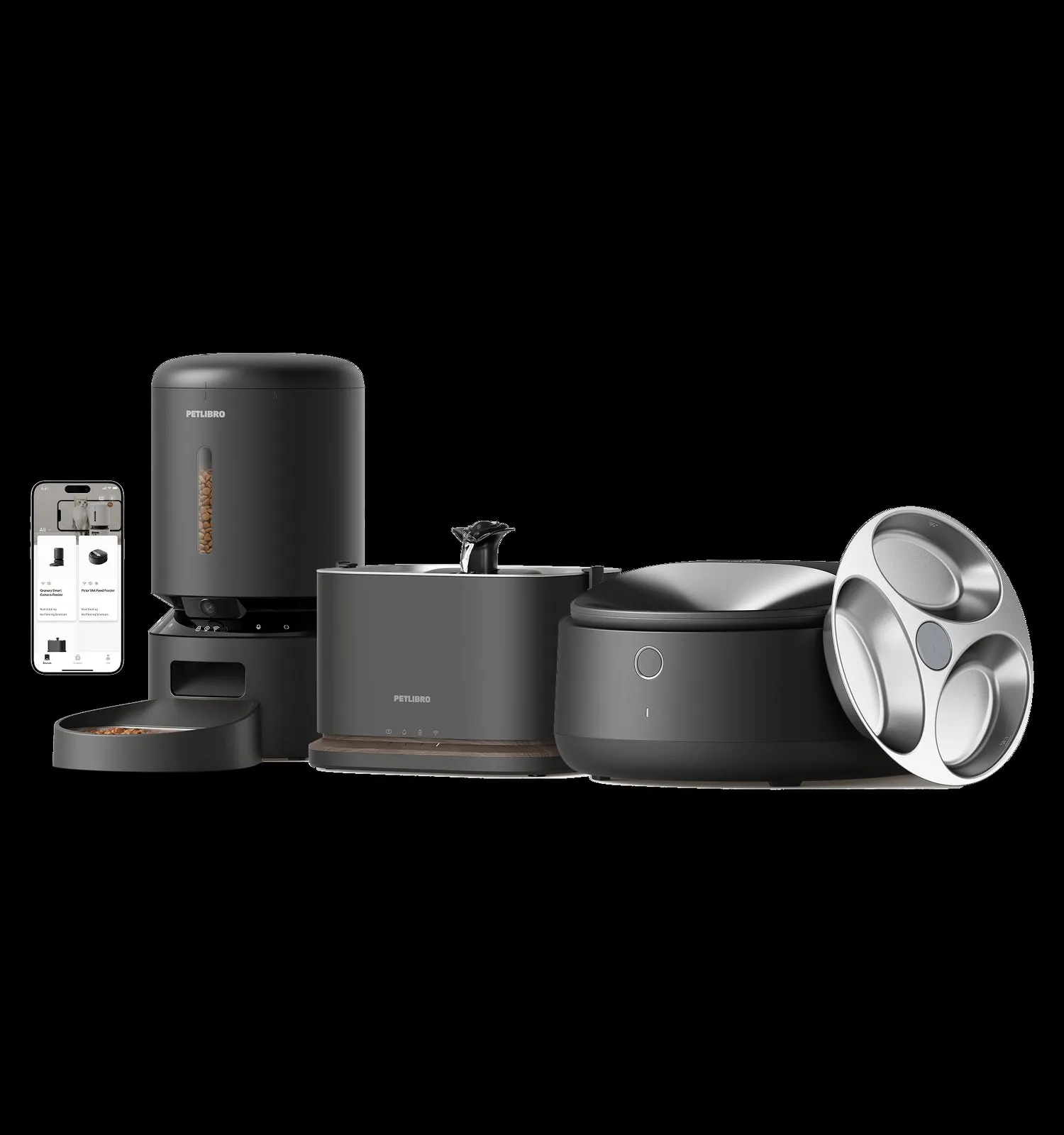
Smart Pet Devices 2026 Category Guide: What 2,000+ Reviews Say
The short answer: automatic feeders and water fountains are the smart pet categories worth buying; pet cameras and GPS trackers bury the real cost in subscriptions; smart litter boxes carry documented safety risk. That is the verdict from 2,000+ Trustpilot reviews across five categories, collected August 2026. This guide scores each category and lists what to buy. I spent two evenings this August reading 2,000+ pet device reviews across five categories, and I came out convinced this industry has a split personality.
Automatic feeders and water fountains mostly do what they promise and earn their price. Pet cameras and GPS trackers bury you in subscriptions. Smart litter boxes carry documented safety risk, which no other category here can say. The numbers come from the Trustpilot profiles for petlibro.com (841 reviews), petkit.com (191), litter-robot.com (567), neakasa.com (125), furbo.com (125), and tractive.com, plus Reddit owner posts, the PETKIT support forum, Best Buy reviews, and a first-party Amazon review set for a PETLIBRO feeder. Scores and prices reflect August 2026 and drift; verify before you buy.
The 2,000+ review read across five categories produces one consistent timeline: failures cluster at 12-18 months in every category, and every device ships with a 12-month warranty. Feeders fail at 6-12 months (PETLIBRO), fountain pumps at 12-14 months (PETKIT Eversweet), litter box sensors at 18-24 months (Litter-Robot 4). Read that as the manufacturer pricing the coverage to expire first. The subscription pattern is equally consistent: cameras gate core features behind plans, Furbo at $60-100/year with 73% one-star; GPS trackers run $8-15/month on top of $99-150 hardware; even fountains lock owners into branded filters at $30-55/year. Only one category carries documented injury and death cases: smart litter boxes, where a Chinese market test of 25 models found only 7 met safety standards. The two categories people actually need, feeders and fountains, hold the healthiest review ratios at 3.8/5 and 3.5/5. That is why the buy list is one feeder, one fountain, and a local-storage camera, with nothing that asks for your card.
How do the five categories score?
The short answer: feeders (3.8) and fountains (3.5) are the buys; litter boxes (3.5) need a brand and warranty check; cameras (2.9) and GPS trackers (3.2) hide traps in subscriptions.
| Category | Avg score | 1-star share | Verdict | Biggest trap |
|---|---|---|---|---|
| Automatic feeders | 3.8 | 28% | Buy | Firmware updates removing features |
| Water fountains | 3.5 | 35% | Buy | Pump dies at 12-14 months |
| Smart litter boxes | 3.5 | 40% | Check brand | Safety + sensor failures |
| Pet cameras | 2.9 | 55% | Caution | Subscription costs |
| GPS trackers | 3.2 | 45% | Depends | Battery life + sub price hikes |
Read top to bottom, it’s boring in a good way: the two categories people actually need have the healthiest ratios. The trap rows are cameras and trackers, where the hardware works and the business model doesn’t. Litter boxes sit in the middle on score but nowhere near the middle on risk. Litter-Robot is 3.1/5 with 47% one-star across 567 reviews. Furbo is 2.7/5 with 73% one-star, the worst profile in the whole dataset. Neakasa is the exception that proves the pattern, 4.2/5 with 22% one-star, except the safety incidents live in that brand’s file. A good average does not clear a documented injury record.
Why does everything fail right after the warranty?
The short answer: failures cluster at 12-18 months while every device ships with a 12-month warranty. Feeders fail at 6-12 months, pumps at 12-14, and litter box sensors at 18-24.
The single most consistent complaint across all 2,000+ reviews is a timeline, not a feature. Failures cluster at 12-18 months in every category: feeders at 6-12 months (PETLIBRO), fountain pumps at 12-14 months (PETKIT Eversweet), litter box sensors at 18-24 months (Litter-Robot 4). All of those ship with a 12-month warranty. Read that as a warning.
Stefano Barboro (IT) on PETLIBRO Polar feeders: “every two or three months one breaks down,” average lifespan “6-7 months,” and he had ordered “over ten.” A Reddit owner on the same brand: “it works great when it works… but it doesn’t work after less than a year. go on amazon and read the 1-star reviews.” A Litter-Robot owner on YouTube ran the arithmetic: “18 months, out of warranty, torque motor issue… pay $55 for replacement motor.”
The nastier flavor is the update regression, where your device doesn’t die so much as get hollowed out one release at a time. Dilek Mir Tekin (US) ran a PETLIBRO feeder for four years and watched updates strip the recorded voice, then sound alerts, then the no-food and offline notifications. Her cat went without food three times before she noticed. “Never trust a brand that doesnt stand for their products.”
Alex (CA) got the other flavor: his Neakasa M1 died completely with no warning at 16 months, past the 12-month warranty, leaving a full-price replacement as the only option. The math is the same everywhere: one year of coverage, failures at 12-18 months. Budget a repair fund per device, or buy only where a longer warranty exists.
When do subscription costs show up?
The short answer: cameras gate core features behind plans, GPS trackers add $8-15 a month, and even fountains lock in branded filters at $30-55 a year. The hardware price is the entry ticket.
Cameras gate core features behind plans. Furbo charges $60-100/year and still sits at 73% one-star. GPS trackers run $8-15/month on top of $99-150 in hardware, and Tractive has moved existing customers onto pricier tiers. Even water fountains lock you into branded filters at $30-55/year. The hardware price is the entry ticket; the monthly cost is where the margin lives.
The billing stories are worse than the prices. A PETKIT owner named Amanda reported she could not stop the renewals: “continue receiving shipments… This is a racket.” Sam (NL) canceled in the app and Google Play kept billing him anyway. Furbo owner Shaka Kane (AU) pays an extra $60/year per camera on top of the base plan. Petcube Bites 2 ($149-199) paywalls treats and full features, and the treat launcher jams on top of that. My rule after reading all of this: read the cancel flow before you subscribe, not after. The reviews are full of people who found out about auto-renewal the hard way.
Which category carries real safety risk?
The short answer: smart litter boxes — the only category with documented injury and death cases, where a Chinese market test found just 7 of 25 models met safety standards.
Smart litter boxes have documented injury and death cases. No other category in this data has fatal incidents. A Chinese market test of 25 boxes found only 7 met safety standards, the closest thing to a published safety standard this category has.
The Neakasa M1 file is the worst in the dataset. A one-year long-term review on Mark’s Tech Blogs documented a verified injury when the unit didn’t stop mid-cycle, and a verified death case Neakasa attributed to stacked faults. The same reviewer found the entry-pad magnet loosening could tip the whole unit at cycle end, and refused to recommend the machine until revised cogs and improved sensing ship in every retail unit. A Sphynxlair forum post reported “a pet injured due to a physical malfunction of the Neakasa M1” and noted Neakasa’s firmware update and anti-inversion add-on.
Litter-Robot 4 owners report failures at scale. The 2026 complaint summary puts 20-25% of owners hitting sensor or mechanical faults within 18-24 months on a $699 machine. One r/DumpsterDiving post (741 upvotes) showed a $700 LR4 next to an apartment dumpster, the category’s review file in one photo. On Reddit, a €1000 LR4 threw a torque error on day five, and replies pointed to hundreds of similar motor issues.
Sensor false readings are the common thread across brands. LR4 owners report sensors that constantly don’t sense. Pura Max units self-trigger cycles on the PETKIT forum. The Luma box sticks mid-cycle every morning; John Hartin on Cats.com: “Every morning I wake up to this litter box stuck half way in cleaning mode… my cats are not even in the room.” When the sensor misfires, the box stops cleaning, and the cats go elsewhere. The box becomes an expensive decoration.
Veterinary guidance from the AVMA emphasizes that weight, appetite, and litter-box habits are core health signals in cats, which is why the litter-box safety record and the paywalled health data both matter more than a star average.
What’s the short version for each category?
The short answer: buy feeders and fountains, check the brand and warranty on litter boxes, and treat cameras and GPS trackers as subscription traps unless your use case demands them.
Automatic feeders: the strongest category, buy one. The core function, reliable scheduled feeding, works, and multi-cat and travel households consistently report the time savings justify the cost. The complaints are specific and survivable. Ana (US) found her PETLIBRO grinds kibble slightly and the app lags. Robert S. (US) found the Wi-Fi drops when the unit runs on batteries, and suspects that’s by design. PetSafe Smart Feed owners on Reddit missed a meal when the app failed and notifications stopped. A PETKIT Fresh Element 3 owner’s weight sensor stopped the feed when the cat touched the bowl, reporting 50g dispensed that never came out, and support’s answer was to feed manually. The Polar wet-food feeder failed on the second day of someone’s trip, the carousel spinning an empty bowl. “This thing is going to get a cat killed.” Buy for the scheduling, verify the failure notifications work, keep a backup plan for travel. The complaints repeat across brands; the PETLIBRO vs PetSafe comparison digs into each.
Water fountains: buy, with a maintenance budget. Cats drink more from moving water and owners confirm it. The trap is the pump: it scales with minerals, fails at 12-14 months, and needs regular disassembly. Budget for a replacement pump and branded filters, and this is the lowest-drama category in the dataset. The water fountain pump guide breaks down which pumps fail and why.
Smart litter boxes: check the brand, check the warranty. The time savings are real. Owners with working units report eliminating daily scooping, roughly 10-15 minutes a day, and a realistic full setup saves 30-60 minutes a day across feeder, fountain, and box. The failure modes are expensive and the safety risk is documented. Buy only with a 2-year warranty and a clean incident record. The two endpoints of this category’s review file: a $600 els pet unit that died at four months, Patricia Ferry (GB) citing the Consumer Rights Act 2015 in her dispute, and that $700 LR4 in the dumpster. I went deeper on the safety file in the Neakasa M1 safety review and the smart litter box buying guide. els pet’s profile, 1.8/5 with 69% one-star, is the worst in the litter box category.
Pet cameras: caution. The worst category by score. The hardware mostly works; the subscription model dominates the reviews. If you only need live video, a no-subscription camera does the job at one-fifth the three-year cost; the no-subscription pet camera guide shows which ones. I would not buy a camera with a mandatory plan in 2026. The data is that clear.
GPS trackers: depends on your pet. For escape artists, a tracker pays for itself the first time it finds the dog. But battery life is short (daily charging on Tractive), subscriptions go up in price, and some owners report failures at the 2-month mark. The pet GPS tracker buying guide covers the full picture; check your use case before buying.
Who should buy what in 2026?
The short answer: multi-cat and travel homes want a feeder plus a local-storage camera, senior cats with urinary history get a fountain, escape-artist dogs get GPS, and apartment dwellers skip the big litter box.
Multi-cat homes with busy schedules want a feeder plus a fountain and should skip the litter box unless it carries a 2-year warranty. Anyone who travels a couple times a year wants a feeder and a local-storage camera, not a camera subscription. Senior cats with a urinary history get a fountain, full stop. Escape-artist dogs get a GPS tracker. Apartment dwellers get a local-storage camera and skip the big litter box. First-time puppy owners get a local camera and a feeder, and skip the AI subscription; train the dog, don’t pay a neural net to watch it.
What does $200 actually buy?
The short answer: a mid-range feeder, a fountain, and a local camera for about $145-165, covering the two highest-value categories plus live viewing, with room left for filters and a pump.
Skip the camera subscription and the GPS tracker unless your pet escapes, and the smart $200 goes like this:
| Item | Price (est.) | Notes |
|---|---|---|
| Mid-range feeder | ~$60 | Check notification reliability |
| Fountain | ~$40 | Budget $15-30 spare pump |
| Local camera | ~$35 | + $10-20 microSD |
| Total | ~$145-165 | Leaves room for filters and pump |
That covers the two highest-value categories plus live viewing, and skips the two where the reviews punish you. Spend the feeder money on reliable notifications, because the feeder is the device people depend on and the one most likely to fail quietly.
What should you check before checkout?
The short answer: warranty versus failure timeline, the cancel flow, safety recalls and 1-star reviews, a spare pump, and the firmware update history.
- Check the warranty against the failure timeline. Twelve months of coverage on a device that dies at 12-18 months is a rental. Look for 2 years or skip.
- Find the cancel flow before you buy. If you can’t see how to cancel, assume it’s a trap. PETKIT and Furbo reviews are full of people who found out otherwise.
- Search “[brand] safety recall” and read the 1-star filter. For litter boxes, the Chinese market test (25 tested, 7 passed) is your safety benchmark.
- Budget a spare pump ($15-30). Warranty repairs are slow and owners replace pumps themselves all the time. It’s a hedge, not a luxury.
- Check the update history. Brands strip features via firmware. Dilek’s feeder lost voice, then alerts, then notifications.
Where did the review data land?
The short answer: the industry builds hardware that mostly works and makes money after the sale. Feeders and fountains are still worth buying, cameras and trackers need caution, and litter boxes need a warranty.
The pet tech industry has figured out two things: how to build hardware that mostly works, and how to make the money after the sale. Feeders and fountains are where the second trick hasn’t fully taken over, so buy those. Cameras and trackers are where it lives, so be careful. Litter boxes are where it gets dangerous, so buy only with a warranty and a clean record. And the two strongest categories are also the two cheapest. A feeder, a fountain, and a local camera run about $150 total, and none of them will ask for your card.
What should you buy?
The short answer: a PETKIT automatic feeder, a PetSafe Smart Feed, a TP-Link Tapo local camera, and a spare fountain pump — all clearing the warranty and no-subscription filters.
Four links, one rule behind them: the product has to clear the two checklist filters, warranty against the failure timeline and no mandatory subscription. Everything here does.
- PETKIT automatic feeder (~$60-90). The brand this review file keeps landing on when the subscription feeders fail, and its feeders run on hardware, not a plan. PETKIT is also the one feeder brand on this page that backs the hardware for two years instead of twelve months, per the brand’s current terms. See it on Amazon. One honest caveat: skip the weight-sensor variant if your cat noses the bowl, because that sensor has a documented false-stop. The plain version doesn’t have the problem.
- PetSafe Smart Feed (~$90-100). The simple, no-subscription counterpoint, and the model PETLIBRO owners land on after the firmware drama. See it on Amazon. Its one documented weakness is the app. Test the notifications during week one and you’ve covered the only real complaint in the file.
- TP-Link Tapo local camera (~$35-40). The no-subscription camera this article keeps pointing at: live view, microSD recording, no monthly fee, and roughly one-fifth the three-year cost of a Furbo. See it on Amazon.
- Spare fountain pump (~$15-30). Order it in the same cart as the fountain. It turns a month-13 failure into a 20-minute swap instead of a dead-fountain weekend. See it on Amazon.
That’s the whole shortlist: one feeder, one camera, and a pump you’ll need anyway. The litter box and the subscription camera stay off it, and the reason is sitting in the scores above.
What a subscription-free setup costs
The quotable version: a feeder, a fountain, and a local camera run about $150 in total, and none of the three ever asks for a card number.
| Item | Price |
|---|---|
| PETKIT automatic feeder | $60-90 |
| Fountain, plus a spare pump | about $40, plus $15-30 for the pump |
| TP-Link Tapo local camera | $35-40 |
| Starter total | about $150 |
FAQ
Which smart pet category is worth the money? Automatic feeders and water fountains. Both solve daily problems and carry the healthiest review ratios in the data: feeders average 3.8/5 with a 28% one-star share, fountains 3.5/5 with 35%, while cameras sit at 2.9/5 and GPS trackers at 3.2/5 with far heavier subscription complaints.
How much time do smart devices actually save? Owners with litter boxes report eliminating daily scooping, roughly 10-15 minutes a day. Feeders remove a twice-daily task when you travel, and fountains cut refills to weekly. A realistic full setup of feeder, fountain, and box saves 30-60 minutes per day, the strongest time-savings case in the category data.
Can you repair these yourself? Pumps and sensors are replaceable parts on most models, and owners do it regularly: a $15-30 spare pump turns a month-13 fountain failure into a 20-minute swap. Warranty repairs are slow, email-only, and sometimes denied at the 12-month mark, so a spare part is a cheaper hedge than a support ticket.
Is the subscription model the future? The subscription trend is real, but the review data punishes it. Brands that paywall core features score worse: Furbo (2.7/5) and els pet (1.8/5) are the worst profiles in the dataset, while no-plan feeders and fountains hold the strongest ratios. Expect the market to drift toward hardware sales with optional services.
Best $200 setup in 2026? A mid-range feeder ($60), a fountain ($40), and a local-storage camera (~$35) covers the three highest-value functions for about $145-165 total, including a microSD card. Skip the litter box unless you have multiple cats and a 2-year warranty, and skip camera and tracker subscriptions entirely.
Which brands should I avoid on review data alone? Furbo (2.7/5, 73% one-star) for cameras and els pet (1.8/5, 69% one-star) for litter boxes. Both profiles are dominated by billing or durability complaints rather than nitpicks, which is why both brands sit in the avoid column of this guide’s scorecard.
How do I check a brand’s incident record? Search the brand name plus “safety recall,” read the Trustpilot 1-star filter, and check the official support forum for pinned failure threads. For litter boxes, the Chinese market test data (25 tested, 7 passed) is the closest thing to a published safety standard.
Updated: August 10, 2026. Data aggregated from Trustpilot profiles (petlibro.com, petkit.com, litter-robot.com, neakasa.com, furbo.com, tractive.com) collected August 2026. Review quotes come from verified purchase reviews. Prices vary; verify before purchase.