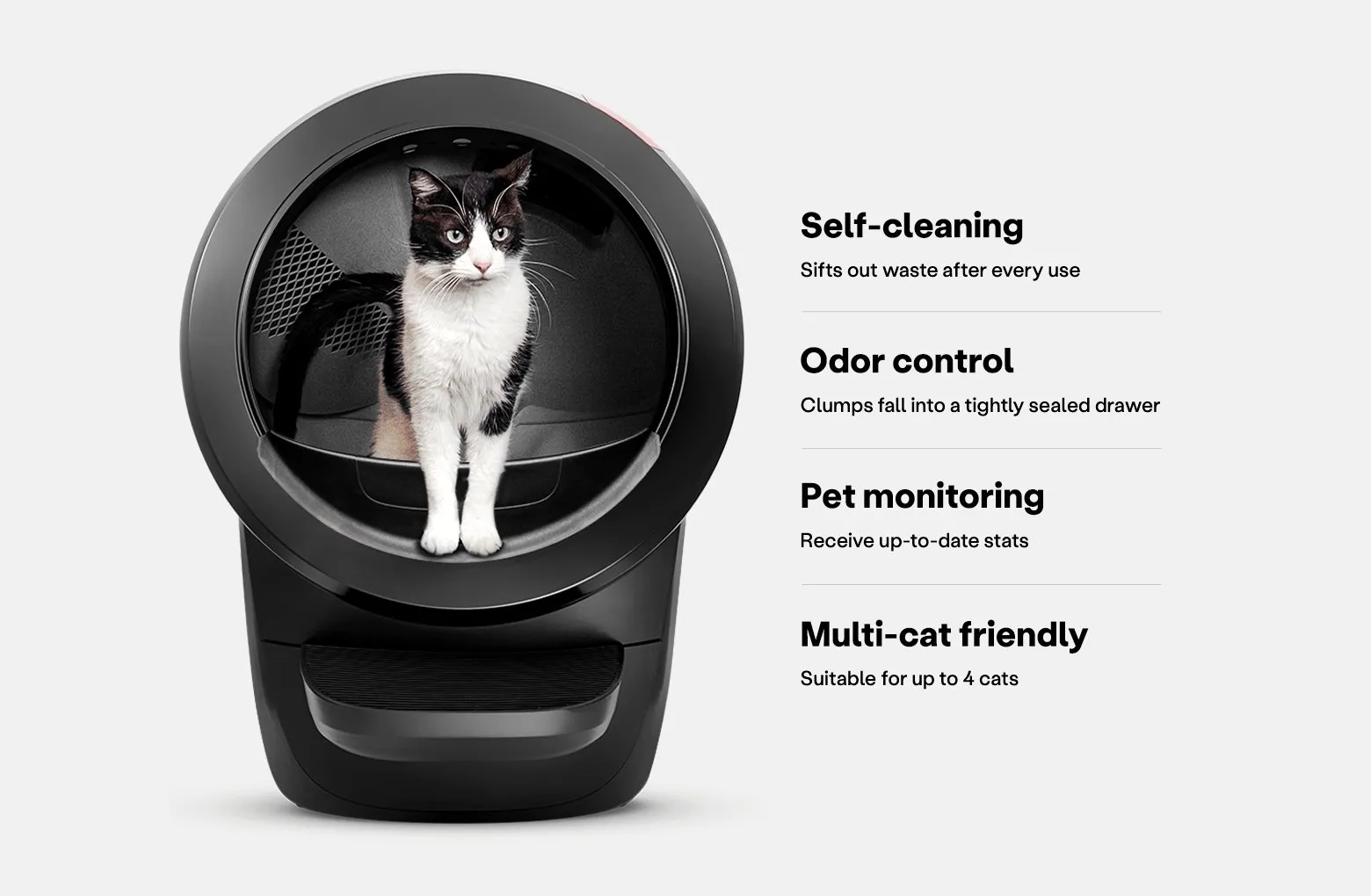
Smart Litter Box Buying Guide 2026: What 1,263 Reviews Say
The short answer: buy a smart litter box only with a two-year warranty, because the failure data says 12 months is a rental. Across 1,263 Trustpilot reviews, one-star shares run from 22% (Neakasa M1) to 69% (els pet), with sensor failures and warranty denials the top complaints, and a Chinese market test finding only 7 of 25 models met safety standards. The pick that survives the data: PETKIT Purobot Max Pro 2.
I spent an afternoon reading the Trustpilot pages for the four leading smart litter box brands, then followed every thread they pointed to: Reddit, YouTube, ComplaintsBoard, a Bilibili video with 163,000 views. The four profiles hold 1,263 reviews between them. The machines run $400-700, and one-star shares reach as high as 69%. “Dies right after the warranty” is the norm, not bad luck.
What surprised me wasn’t the failures. It was how predictable they are. Three things decide whether you get a helper or a $600 paperweight: sensor design, warranty length, and the incident record. If you’re new to the category, the smart pet devices overview is the better starting point. This one goes straight at the failure data.
The failure data lines up across every brand: sensors fail, warranties run out first, and consumables add up. Across four Trustpilot profiles holding 1,263 reviews, one-star shares run from 22% (Neakasa M1) to 69% (els pet), with Litter-Robot 4 at 47% and PETKIT Pura Max at 41%. The top complaints are sensor false readings, full-tray dumps, and warranty denials. Every brand’s spec table shows a 12-month warranty on machines priced $400-700, while owners document failures at 12-18 months, like Alex in Canada whose Neakasa died completely at 16 months and whose only option was full-price replacement. A Chinese market test of 25 smart litter boxes found only 7 met safety standards, and the Neakasa M1 file includes documented injury cases plus a required firmware update and anti-inversion add-on. The one box in this data whose warranty outlasts the failure window is the PETKIT Purobot Max Pro 2 with its 2-year standard warranty, which is why owner communities point to it when the incident record comes up.
What do the Trustpilot scores actually show?
The short answer: one-star shares run from 22% (Neakasa M1) to 69% (els pet), with Litter-Robot 4 at 47% and PETKIT Pura Max at 41%, a category where warranty denials and sensor failures dominate.
| Brand | Trustpilot Score | 1-star share | Core complaints |
|---|---|---|---|
| Litter-Robot 4 (Whisker) | 3.1/5 (567 reviews) | 47% | Sensor false readings, full-tray dumps, torque motor failures |
| PETKIT Pura Max | 3.5/5 (191) | 41% | Fails within a year, sensor oscillation, hard-to-cancel auto-renewal |
| Neakasa M1 | 4.2/5 (125) | 22% | Dies after warranty, warranty denials, owner does the repairs |
| els pet | 1.8/5 (380) | 69% | Dies within months, sensor “stuck” errors, refund refusals |
The sample sizes are all over the place. Litter-Robot’s 567 reviews is a real dataset; Neakasa’s 125 are enough to show a pattern but not to call it proof. els pet scores worst in the category at 1.8/5, with 69% of its 380 reviews at one star. CATLINK, the biggest Chinese-market brand, doesn’t have a Trustpilot profile at all. I checked. Its complaints live elsewhere, including a Bilibili review titled “2000块买了个祖宗”, roughly “spent ¥2000 and bought a tyrant”, which has 163,000 views. That many people wanted to watch a stranger regret a purchase.
Why do the sensors fail so often?
The short answer: optical and weight sensors sit inside a box full of dust and cat hair, so beams get coated and readings drift, producing “always full” errors and phantom cats.
The most common complaint isn’t a broken motor. It’s the box deciding that reality is wrong.
Kent in the US ran an LR4 for six months before it started reporting an “always full” error and dumping the entire contents into the tray:
“It’s like having another pet you have to take care of, that is always sick.”
On r/litterrobot, a brand-new unit threw torque errors on day five and ended up “stuck upside down”; the top reply told the owner to “google any combination of ‘lr4 over torque’ and you’ll find hundreds of similar issues.” On YouTube, one owner summed up weeks of this: “sensors constantly not sensing… erroring for full box.”
The phantom cat is the cruelest version. A PETKIT PuraX owner watched the app report “cat in the litter box” mid-cycle when no cat was near it, and when the owners are out, “our cats can’t go to toilet and they will have to hold for 8-9 hours.” John Hartin’s PETLIBRO Luma sits “stuck half way in cleaning mode saying the weight sensor detects a cat” every morning, with an empty room. He unplugs it daily. The cats pee on the floor when it jams.
The reason isn’t mysterious. Optical and weight sensors sit inside a box full of dust, cat hair, and litter. Dust coats the beam, the weight reading drifts, and the box misjudges. That’s a design flaw, not a defect lottery. Sara, an els pet owner, put it well:
“most times it’s erroring in a ‘stuck’ mode bc of sensors and not really being stuck!”
If you have a long-haired cat, budget for weekly sensor cleaning or skip the category entirely. When the sensors do lie, the DIY repair guide covers what owners actually do about it.
What happens when the warranty runs out?
The short answer: owners face full-price replacement. Alex’s Neakasa died at 16 months past the 12-month warranty, and support loops stretch for months while the box sits dead.
Alex in Canada bought a Neakasa M1. At one year and four months it “died completely with no warning.” The 12-month warranty was long gone, and the only option was a full-price replacement. He moved to the PETKIT Purobot Max Pro 2 specifically for its two-year warranty.
That story repeats across every brand in the data. John in the UK bought four units for £2000; problems started within five weeks, and he spent 17 months emailing support while they “asked for serial numbers over and over” and never honored the warranty. Patricia Ferry’s els pet “ceased functioning after only four months of normal domestic use.” She cited the Consumer Rights Act 2015, and after months of correspondence the company still refused a remedy. On ComplaintsBoard, an LR4 owner laid out the arithmetic: “$799 on the unit, I also purchased the hopper for another $100 and to get 7 or 8 months out of it?” The gears died at 7-8 months.
The most damning complaint is the shortest:
“$700 for 1 year — this is the reality.”
Another owner paid $55 for a replacement torque motor at 18 months, out of warranty. On r/DumpsterDiving, an LR4 found next to an apartment dumpster got 741 upvotes and one caption: “This is a $700 machine.”
PETKIT owners describe a standard script when the box dies: out of warranty, the company offers 30% off the same product, in one review’s words “give a 30% discount to by the same crappy product again”, or suggests fixing it yourself. Bestie Paws’ review of LR4 complaint data puts the failure rate at 20-25% of owners within 18-24 months, on a $699 appliance with a one-year base warranty.
I checked the warranty column of my own spec table twice. Every row says one year. A 12-month warranty on a $500 machine is the manufacturer telling you what it expects. Look for two years or more.
Are smart litter boxes safe?
The short answer: not all of them. The Neakasa M1 has documented injury and death cases, and a Chinese market test found only 7 of 25 models met safety standards.
Then there’s the category of complaint I don’t have a snappy line for.
Neakasa M1 has documented cases of serious injury and death to cats, including a unit that kept cycling and flipped over while a cat was inside. A long-term reviewer who runs the official user group, Mark’s Tech Blogs, wrote:
“No one should buy this machine!”
…until every retail unit ships with the revised cog and improved sensing. On the Sphynxlair forum, an owner reported:
“a pet injured due to a physical malfunction of the Neakasa M1”
Neakasa was releasing an add-on to stop the litter basin from inverting fully, plus a required firmware update. I went through the full incident record, the warranty language, and the support threads in the Neakasa M1 deep dive.
And this isn’t a one-brand problem. A Chinese market test of 25 smart litter boxes found only 7 met safety standards. Seven out of twenty-five. Price is not a safety signal.
If you leave a box running unattended, check your model’s incident history before you trust it. If a unit injures an animal, report it to the CPSC at cpsc.gov so it lands in the public incident database. I don’t care how good the app is.
Veterinary guidance from the Cornell Feline Health Center notes that cats should be supervised around new automated equipment and that changes in litter-box habits can signal health problems, two reasons the safety and sensor failures in this data matter clinically.
How much do smart litter boxes really cost?
The short answer: $400-700 up front plus $30-55 a year in bags and filters, and more if the brand forces proprietary liners or litter. The sticker price is the entry fee.
The LR4’s waste drawer sits near-sealed and traps moisture, which is why owners keep buying OdorTrap refills, and the hopper is a separate $100 add-on. Nathan Preston’s summary of his unit:
“stops working consistently, smells horrible, impossible to clean.”
Kathryn’s is shorter:
“Disconnects all the time. Dumps all litter.”
The PETLIBRO Luma’s fabric liner is “both expensive and less durable than promised” (ShopSavvy), its waste container is shallow enough that “full” alerts fire early, and the liner isn’t waterproof. Neakasa owners report large urine clumps missing the waste port, grime building up behind the unit, and an app that misattributes weight between cats.
Budget $30-55 a year for bags and filters, and more if the brand forces proprietary liners or litter. The sticker price is the entry fee, not the bill.
Do any owners actually like their box?
Yes, about a quarter of Litter-Robot’s profile is 4-5 stars, praising the saved scooping, odor control, and weight tracking. The owners with working units genuinely love them.
It’s not all horror stories. About a quarter of Litter-Robot’s profile is 4-5 star reviews, and they consistently say the same three things: the box genuinely saves daily scooping, odor control works, and the app tracks weight well. Several still note the $699 price and the mandatory litter brand. Neakasa’s 4.2/5 comes with praise for the open-top design and the app; its 22% one-star share still clusters on warranty and longevity. The owners who got a working unit love it. The failure rate is what drags the scores down. For the full picture on what owners actually praise, the 2026 owner-love roundup walks through the positive piles brand by brand.
How do the models compare side by side?
The short answer: they span $332.99 (M1 Plus Lite promo) to $699 (LR4 plus a $100 hopper), all with 1-year warranties, and Trustpilot scores from 1.8 to 4.2.
| Model | List price | Warranty | Waste capacity | Trustpilot |
|---|---|---|---|---|
| Litter-Robot 4 | ~$699 (hopper +$100) | 1 year | 3-gallon drawer (per Whisker) | 3.1/5 |
| Neakasa M1 | $599.99, ~$376 in spring promos | 1 year | ~6L bin (per Neakasa) | 4.2/5 |
| Neakasa M1 Plus Lite | ~$332.99 (promo) | 1 year | n/a | n/a |
| PETKIT Pura Max | not collected | 1 year | n/a | 3.5/5 |
| els pet | ~$300-600 by model | varies | n/a | 1.8/5 |
Capacity figures come from the manufacturers’ product pages, and prices shift with promos. Verify before you buy. The promos are also how a one-year warranty hides inside a discount.
What should you check before buying?
The short answer: count warranty months, check the sensor design, add consumables to the price, search the incident record, ask what happens offline, match drawer size, and buy with a real return window.
- Count the warranty months first. Two years minimum; anything with 12 months is a no. Alex’s move to the two-year Purobot Max Pro 2 is the pattern to copy.
- Check the sensor design. Removable, cleanable sensors beat sealed units. Read the maintenance section of the manual before you buy, not after.
- Add consumables to the price. Bags, filters, and liners run $30-55/year, and the LR4 hopper costs $100. Some boxes force proprietary litter.
- Search the model name plus “incident” or “injury” before checkout. One search beats a refund fight later.
- Ask what happens offline. LR4 owners built a cloud-free firmware (r/homeassistant, 373 upvotes) because the box depends on Whisker’s servers. If your Wi-Fi drops, does the box still cycle?
- Match drawer size to cat count. Multi-cat households fill shallow drawers fast, and Luma owners complain about premature “full” alerts.
- Buy from a retailer with a real return window. Brand-direct purchases left several owners fighting chargebacks.
Which smart litter box should you buy?
The short answer: the PETKIT Purobot Max Pro 2 — the one box in the data whose 2-year warranty outlasts the failure window, with complaints skewing to connectivity rather than safety.
If you’ve run the checklist above and you’re still buying, here’s our top pick in the data: PETKIT Purobot Max Pro 2 (see it on Amazon). It’s the unit Alex moved to when his Neakasa died at 16 months, specifically for the two-year warranty, and it’s the same pick the owner communities point at when the Neakasa M1’s incident record comes up.
One clarification, because it matters: the Purobot Max Pro 2 is not the Pura Max or the PuraX criticized above. This is the model with the 2-year standard warranty, and its complaint pattern in the owner forums skews to connectivity and consumables rather than sensor deaths or safety incidents. It is not incident-free, nothing in this category is, but it’s the one box in this data set where the warranty outlasts the failure window, which is the single spec everything else fails.
Still apply the checklist: count the warranty months (two, here), clean the sensors when the manual says to, and budget for bags and filters. A two-year warranty doesn’t mean zero maintenance. It means the manufacturer is betting the box lasts, which is more than the one-year brands are willing to bet.
Who should buy a smart litter box, and who shouldn’t?
The short answer: buy for multi-cat homes, travel, or mobility needs; skip for one cat on a budget, long-haired cats you won’t clean for, or any model with a 12-month warranty.
Buy if you have multiple cats and scooping twice a day is the main chore. Buy if you travel regularly and can’t leave a manual box unattended. Buy if bending over is genuinely painful, because the no-bending pitch is real when the unit works.
Skip it if you have one cat and a tight budget, since a manual box and a scooper are cheaper and more reliable. Skip it if you have a long-haired cat and won’t clean sensors weekly. Skip it if you can’t tolerate downtime, because when the sensors misfire your cat holds it, and the PuraX owner documented 8-9 hours. And skip anything with a 12-month warranty. That’s the manufacturer budgeting for your second unit.
Smart litter boxes aren’t a scam. The 4-5 star reviews are real, and a working unit genuinely kills the daily scoop. But $600 buys a sensor array that lives inside a box of dust and cat hair, carries a one-year warranty, and sits on a brand where 22-69% of owners end up at one star. The warranty is the one spec the marketing page is quiet about. Read it before you spend.
FAQ
Is a smart litter box worth it? For multi-cat households or frequent travel, yes. For one cat on a budget, a regular box plus a scooper is cheaper and more reliable. The reviews that praise these boxes come from owners who use them daily; the complaints come from owners whose sensors failed within the first year.
Which brand fails least? Neakasa has the highest score in this data (4.2/5) but a small sample. Litter-Robot has the most reviews and the worst 1-star share among the three big names; els pet scores worst in the set at 1.8/5. Neither is a safe bet without checking the warranty first.
What warranty length is normal? Two years is the baseline for a $400+ appliance. Anything shorter means the manufacturer doesn’t expect it to last. Most boxes here ship with 12 months, which lines up with the “dies after the warranty” complaints, so treat a one-year warranty as the failure clock.
My box broke with a cat inside. What do I do? Stop using it immediately, remove the cat, and contact the manufacturer. If the unit caused injury, report it to the CPSC (cpsc.gov) so it shows up in the incident database. Keep photos, video, and the purchase receipt; several owners needed them for months-long disputes.
Why do the sensors fail so often? Optical and weight sensors sit inside a box full of dust, cat hair, and litter. The dust blocks the beam or the weight reading drifts, and the box misjudges. Removable, cleanable sensors are the design that fails least; sealed units force a repair call.
Are cheap smart litter boxes safe? A Chinese market test of 25 models found only 7 met safety standards, so price alone is not a safety signal. Search the model name plus “incident” or “injury” before buying, and check whether the manufacturer has shipped safety retrofits like Neakasa’s revised cog.
What do consumables really cost? Bags and filters run $30-55/year on most boxes. Luma’s fabric liner costs more and wears out faster than promised, the LR4 hopper adds $100 up front, and OdorTrap refills keep owners reordering. Budget for these consumables before comparing sticker prices.
Updated: August 10, 2026. Review data from the litter-robot.com, neakasa.com, elspet.com, and petkit.com Trustpilot profiles, collected August 2026. Quotes are from verified reviews. Prices and warranty terms change; verify before purchase.