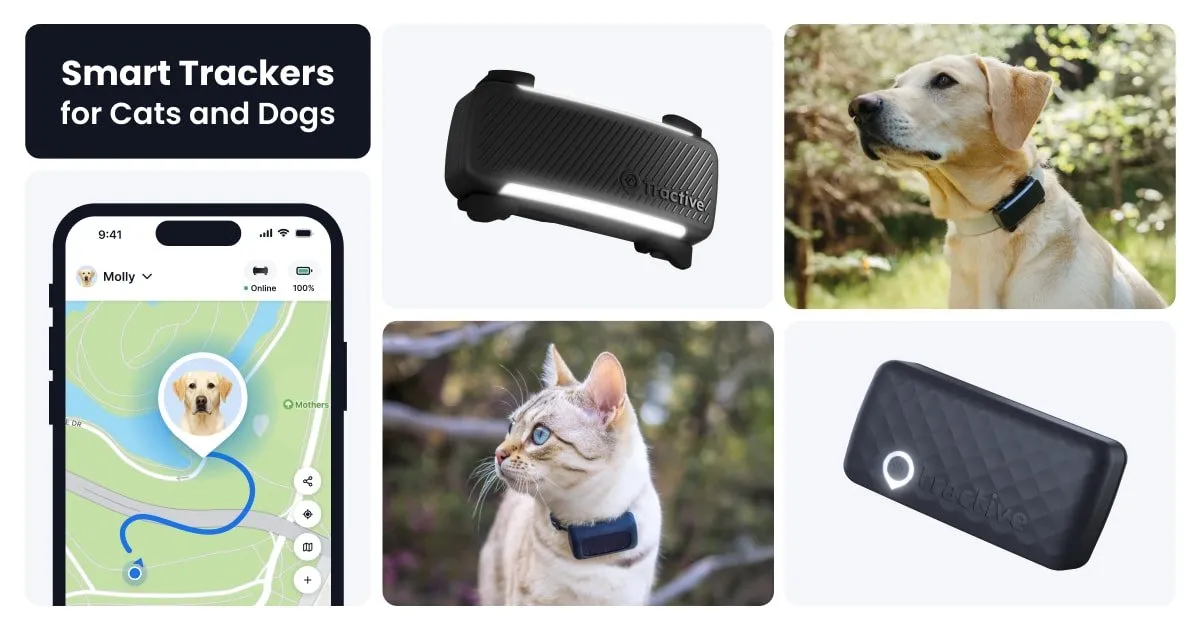
Pet GPS Trackers 2026: Battery Life and Subscription Reality
The short answer: a pet GPS tracker earns its price only when it finds an escaped pet. Tractive owners report one to two days of battery against seven claimed, price hikes after purchase, and failures inside two months. If the escape is real, buy; if hypothetical, a $25 Bluetooth tag covers the home range. I spent an evening in the owner forums for this one: Reddit’s r/dogs and r/FiDogCollar, the Tractive owners group on Facebook, Tractive’s Trustpilot page, the BBB files, WIRED’s 2025 review of the Smart Cat Tracker, and a long-term test in the Three Retrievers newsletter.
The complaints line up so consistently across brands that it stops looking like a coincidence. Battery first, subscription second, hardware that dies too young third. In that order, every single time.
The other 364 days it’s a monthly bill and a charging ritual. Whether those days are worth it depends on your pet, your habits, and how you feel about prices that go up after you’ve bought in. I walked the whole smart-pet category in the 2026 category guide before this one, and GPS is the most lopsided product in it: the hardware mostly works, the business model mostly doesn’t. Here’s what owners actually report, not what the marketing pages claim.
The complaints line up so consistently across brands that it stops looking like a coincidence: battery first, subscription second, hardware that dies too young third. Tractive advertises up to seven days of battery and owners report one to two; Fi’s Series 3 claims about a week and delivers three to seven. The Three Retrievers tester measured about a third of the claimed battery, and WIRED found near-daily charging for outdoor pets. The subscription moves after you commit: Tractive runs $8-15/month with owners moved onto pricier tiers without notice, and Fi runs $15-20/month while collars stop charging around the one-year mark. Over three years, a Tractive setup runs roughly $390-690 and a Fi setup $690-870, against $20-35 for a Bluetooth tag with no subscription. The virtual fence, the headline feature, fails in documented ways: it does not fire at distance, live tracking rarely works, and units drop offline for 16+ hours without an alert. Treat the tracker as a search aid, not a guarantee.
How often do you really need to charge it?
The short answer: far more often than claimed. Tractive’s advertised seven days delivers one to two, Fi’s “about a week” delivers three to seven, and WIRED measured near-daily charging for outdoor pets.
Tractive advertises up to seven days of battery. Owners report one to two. Fi’s Series 3 claims about a week and delivers three to seven. Budget Bluetooth tags claim months and mostly deliver, landing somewhere in the 30-90 day range on a coin cell. Different tools, different jobs, and I’ll get to the tags later.
The gap between claimed and delivered battery is the single most repeated complaint in every forum I read. The Three Retrievers tester measured it: “about a third of what they claim. They say the battery should last for seven days, but it only lasts about two days for me.” WIRED saw the same split with the Smart Cat Tracker: roughly five days for an indoor cat, and near-daily charging for a pet that roams outside. A r/dogs regular summarized the lifestyle bluntly: “Be ready to charge daily and submit for replacement trackers when the battery starts going bad.”
The charging itself isn’t the killer. The window it opens is. A collar tracker is off your pet for an hour every day while it charges, and escapes don’t schedule around your routine. WIRED adds a worse wrinkle: a lost pet’s battery drains fast outside the safe zone, within hours in their testing. The one moment you need the tracker most is the moment it’s most likely to be dead. Treat it as a search aid, not a guarantee.
Expert guidance from the ASPCA on pet safety emphasizes that identification — a collar tag, a microchip, and current contact information — is the foundation of lost-pet recovery, with GPS tracking as a supplement rather than a replacement.
One genuine fix exists, and it’s small: Tractive’s power-saving zones that recognize your home Wi-Fi. Owners report the battery behaves noticeably better with them configured, and one said the app itself worked better afterward. It won’t turn a two-day tracker into a seven-day one, but it’s worth the ten minutes during setup.
How much does the subscription really cost?
The short answer: Tractive runs $8-15 a month and Fi $15-20 a month, with owners moved onto pricier tiers without notice. A three-year Tractive setup runs roughly $390-690.
The hardware is the entry fee. The subscription is the product, and the price moves after you’ve committed. Tractive runs $8-15 a month depending on the plan, and Reddit threads document owners being moved onto more expensive tiers without notice. The thread title does the summary for me: “Anyone else use Tractive and shocked at the subscription increase?”. Axel Björnsson, in Iceland, put the year-one sticker shock more bluntly on Trustpilot: “I already paid for the device and now I have to pay a subscription to make the thing work.”
Fi asks more, roughly $15-20 a month, and owners say its hardware fails before the plan does. One unit stopped charging about a year in; the charging base connection died. You’re paying for the plan and the collar dies first, which is a special kind of subscription math. The same pattern runs through the pet camera category, where I priced out every major plan in the subscription cost comparison: the hardware is the loss leader, the plan is the margin.
Here’s the three-year picture, roughly:
| Tracker | Device (est.) | Subscription | 3-year total (est.) |
|---|---|---|---|
| Tractive | $99-150 | $8-15/month | $390-690 |
| Fi Series 3 | ~$149 | $15-20/month | $690-870 |
| Bluetooth tag | $20-35 | $0 | $20-35 |
Treat those as planning numbers, not quotes. Both companies have changed pricing on existing customers, so the real total is whatever the plan costs in years two and three, not what the promo said in year one. Budget the year-two price or don’t budget at all.
Does the hardware outlast the subscription?
No, usually not. Fi collars stop charging around the one-year mark, and Tractive units show offline errors, missing GPS, and false alerts within the first two months.
Fi owners report collars that won’t charge or lose their base connection roughly a year after purchase. An owner in r/FiDogCollar described a collar that stayed dead for two full years and then came back on its own after an update: “My Fi collar started working after 2 years of being broken, after updates.” That’s not a fix, that’s a miracle, and you should not plan around it. Owners of the newer Series 3+ report more problems than the old Series 2, which is backwards for a product line.
Tractive’s failure pattern is faster and stranger. Multiple reviews describe offline errors, missing GPS, and false alerts within the first two months of ownership. A member of the Tractive owners group on Facebook wrote the fullest account I found: “I had ongoing problems with my original DOG 6 and XL trackers (offline/no GPS, charging failures, unresponsive, false alerts) roughly 2 months after I purchased them. One was replaced via Amazon, one refunded after lengthy ongoing emails to Tractive and hours wasted.”
Support, when the hardware fails, is email-only and slow; owners describe weeks of back-and-forth. Steve, in the UK, was a week into waiting on Tractive’s “experts” to assess his replacement claim while his cat’s tracker drained in under 20 hours. The pattern across both brands: the subscription outlives the hardware, and the company treats the failure as your problem. If you’re handy and out of warranty, the DIY repair guide covers the fixes owners actually pull off; charging-contact corrosion is one of them.
Does the escape fence actually work?
Not reliably. Owners report it fails to fire at distance, live tracking rarely works, and a tracker dropped offline for 16+ hours without an alert.
The virtual fence alert is why most people buy these things. It fails in specific, documented ways. A long Reddit review of the Tractive captured all three, and they’re worth reading before you hand over money:
- The fence doesn’t fire when it should. “it does NOT notify when she leaves the virtual fence. Apparently, the device is still connected to wifi… more than a block from the house.”
- Live tracking barely works. “in all my testing, I’ve only gotten the live tracker to work once.”
- The device goes silent and stays silent. One owner’s tracker dropped offline for 16+ hours with no GPS, network, or Wi-Fi, no alert raised, and it wouldn’t reconnect to the home Wi-Fi afterward.
Wi-Fi compatibility is a known limitation, not a one-off glitch. The Three Retrievers tester’s unit wouldn’t join his network at all, and Tractive’s own response was that the tracker “is not compatible with all WiFi types.” The on-collar beep won’t save you either: WIRED measured it as extremely quiet.
If the fence is your reason to buy, test it on day one. At distance. With the house Wi-Fi on, then off. That’s the only way to learn the failure modes before you need them, and the reviews suggest you will need them.
Who should actually buy a GPS tracker?
The short answer: owners whose pets genuinely escape, such as escape artists, hunting breeds, and newly adopted pets, plus travelers who confirm cellular coverage; everyone else is better off with a tag.
Buy if your pet escapes regularly: escape artists, hunting breeds, newly adopted pets. That’s the one case where the tracker pays for itself, and charge discipline is the price of admission. Budget the daily charge into your routine or it won’t be there when the dog bolts.
Travel is a decent reason too. Cellular coverage works in unfamiliar places, as long as you check that the tracker’s carrier actually covers where you go. Subscriptions route through one network, so coverage maps matter.
Skip it if your pet is home-bound or supervised, if you won’t charge a device daily, or if you’re buying just in case with no plan to keep the subscription. That last one is the most common waste in the forums: owners buy a tracker for a newly adopted pet’s risky first month, then cancel once the pet settles. Fine, just cancel before the renewal date.
Two use cases deserve specifics. Senior dogs: Fi markets health tracking, activity and sleep, and owners report the collar data, not the GPS, is the ongoing value there. Check what the app actually records before paying for it. Apartment dwellers: GPS needs a sky view, and indoors it falls back to Wi-Fi and Bluetooth positioning, which is weak. A Bluetooth tag covers your home range for a fraction of the cost.
Hunting or rural owners get the one real advantage of GPS over Bluetooth: trackers work anywhere with cellular coverage, which is often the deciding factor. Confirm coverage on the routes you actually run, not the ones on the marketing map.
What’s the $25 alternative to GPS?
The short answer: a Bluetooth tag like an AirTag. An AirTag runs $20-35, no subscription, months on a coin cell, and enough range for yards and apartments, though it needs your phone nearby.
For indoor tracking and fence alerts, Bluetooth tags, Tile and AirTag-style, cost $20-35, need no subscription, and run for months on a coin cell. Range tops out around 100-300 feet, but for home use that covers most escape scenarios at a tenth of the three-year cost. It’s the same conclusion my no-subscription pet camera guide reached: a paid plan is a choice, not a requirement, and the free tier is often enough.
They fail where GPS works: they need your phone nearby, and they can’t report location to the cloud on their own. AirTags lean on the Apple device network, so they only work where iPhones are. For a yard, a tag covers it. For a dog that bolts across town, only GPS does. They’re complements, not substitutes: a $25 tag for home, a GPS subscription only if the escapes are real.
What should you check before buying a tracker?
The short answer: confirm the escape is real, test the battery for a week, test the fence at distance, budget year-two subscription prices, read the cancel flow, and keep the charger accessible.
A checklist distilled from the owners who got burned:
- Confirm the escape is real before you pay for a plan. A subscription for a home-bound dog is a donation.
- Test the battery with your actual usage for a week before you trust it. Claimed days are not delivered days.
- Test the fence and the offline alert on day one, at distance, with the Wi-Fi on and off. This is the feature failing most in the reviews.
- Budget the subscription at year-two prices, not the promo. Both brands have raised prices on existing customers.
- Read the cancel flow before subscribing. If it’s buried, assume the plan is sticky.
- Keep the charger somewhere you can’t miss. Daily charging is the top complaint on every brand, and the charging contacts are the other weak point: owners report corrosion there even on IP67/IP68-rated trackers that survive swimming.
Which tracker should you buy?
The short answer: an Apple AirTag for home-range coverage at about $25, or a Fi Series 3+ only if your dog actually bolts across town and you accept daily charging and plan creep.
Two answers, because this category splits cleanly on whether the escape is real.
- Apple AirTag: see it on Amazon (or the 4-pack, which covers multiple pets for about $25 per tag). The no-subscription pick: ~$29, runs for months on a coin cell, no monthly bill, no account to cancel. It covers a yard, an apartment, and most home-range escape scenarios. It fails exactly where Bluetooth fails: it needs your phone and Apple devices nearby. For indoor and yard coverage, this is the whole answer.
- Fi Series 3+: see it on Amazon. The pick if your dog actually bolts across town and you need cellular GPS anywhere with coverage. Buy it knowing the two caveats documented above: budget the daily charging ritual into your routine, and budget the plan at year-two prices, not the promo. It’s the tracker whose escape-finding capability justifies the hassle, if the escape is real.
If you’re still deciding between the two, the checklist in the section above decides it for you. Confirm the escape is real first. If it is, the Fi earns its subscription the day it finds your dog. If it isn’t, the AirTag covers the home range at a tenth of the three-year cost, and you never touch a renewal date.
What’s the bottom line?
The short answer: the technology works but the business model doesn’t. Daily charging, two-year hardware, email-only support, and creeping subscriptions make GPS a buy only when the escape is real.
The technology works. The business model doesn’t: a subscription priced like a service, attached to hardware that needs daily charging and fails inside two years, supported by email-only ticket queues. The reviews read like a category-wide warning, not a brand-specific one, and I’d say the same about the next tracker that launches next year until one of them ships a collar that lasts a week and a plan that doesn’t creep. The positive-review roundup on this site shows the same split from the other side: even satisfied owners praise the hardware, never the plan attached to it.
If your dog actually escapes, a GPS tracker is worth the hassle. Charge it every day, test the fence, and treat it as a search aid, not a guarantee. If the escape is hypothetical, buy the $25 tag and skip the monthly bill. Your wallet will thank you, and so will the battery.
FAQ
What is the difference between GPS and Bluetooth trackers? GPS trackers use satellite positioning and work anywhere with cellular coverage, but they need an active subscription and near-daily charging. Bluetooth tags work only within ~100-300 feet of your phone, with no subscription and months of battery life on a coin cell. For indoor and yard coverage, Bluetooth is the cheaper tool.
How much does a pet GPS subscription cost? Tractive runs $8-15/month billed annually or quarterly, and Fi runs about $15-20/month. Both brands have raised prices on existing customers, so budget at year-two prices, not the promo rate. A Bluetooth tag costs $20-35 total with no plan at all.
Are pet GPS trackers waterproof? Most GPS trackers are rated IP67 or IP68 and survive swimming. The charging contacts are the weak point: owners report corrosion there even on waterproof-rated units, which eventually kills charging. Wipe the contacts dry after wet outings and keep the charger in a visible spot.
Does a tracker work indoors? GPS needs a sky view, so indoors trackers fall back to Wi-Fi and Bluetooth positioning, which is less accurate. If indoor tracking is the priority, a Bluetooth tag is more reliable and cheaper. GPS earns its subscription when the pet leaves the home range, not inside it.
Why does my Tractive battery die in a day? The tracker polls GPS and cellular aggressively in motion and outside Wi-Fi safe zones. WIRED measured near-daily charging for outdoor pets, against the seven days claimed. Power-saving zones that recognize home Wi-Fi help; one owner reported the app worked better with them configured.
Can I use a tracker without a subscription? No. Both Tractive and Fi require an active plan for GPS tracking and app features; the hardware is useless without it. If you will not pay monthly, buy a Bluetooth tag: $20-35, no subscription, months of battery, and it covers home-range escapes.
What happens if my pet is lost and the battery is low? WIRED reports the battery drains within hours outside the safe zone, so a low battery at the wrong moment is a real risk. Charge fully before walks or travel, keep the tracker in a power-saving zone at home, and treat it as a search aid, not a guarantee.
Updated: August 10, 2026. Review data from Trustpilot, Reddit, Facebook owner groups, WIRED (November 2025), and owner long-term tests, collected August 2026. Prices and plans change; verify before purchase.