Dog Collars and GPS Fences: 3 Checks Before You Buy
The short answer: a collar that comes off and a boundary that sounds inside its own line are the same kind of failure, and on the dog side of pet tech it is the only kind that matters. On September 22, 2026, a buyer of the $99.99 PetSafe Pro Dog Trainer wrote on Trustpilot that the collar came off within the first hour. On the same page, filed the same day, another buyer wrote that their dog had been shocked inside the perimeter of a Guardian GPS fence, that it was awful getting the collar back off her, that the unit now runs on pulse only and still beeps regularly, and that support told them the house was blocking the GPS. Both products work as designed. The design is where the problem sits.
petiqlab has not tested a training collar or a containment fence, and nothing below is a recommendation of either. Everything here comes from three places read on September 28, 2026: the makers’ own product pages and specification tables, the reviews filed on those pages and on Trustpilot, and owner threads from the last month. Dog-side coverage is new for this site, which until now has reviewed feeders, fountains, cameras and litter boxes. That cat-heavy archive is exactly why the difference is worth writing down. Trustpilot read the same day put petlibro.com at 3.4 from 1,009 reviews with a badge showing replies to 70% of negative reviews within two weeks, and petsafe.net at 2.1 from 231 reviews with no reply badge at all.
A cat device that fails costs you a meal. A dog device that fails costs you the dog.
The asymmetry is not marketing. It comes from what each device is allowed to do when its inputs go wrong.
| Device | The cat-side failure | The dog-side failure |
|---|---|---|
| Automatic feeder | A missed meal, and a cat that is home all day anyway | The same missed meal, on an animal that may be alone for ten hours |
| Camera | A clip you never watched | The one minute you needed, gone |
| GPS tracker | A cat that slipped its collar indoors | A dog that slipped its collar near a road |
| Containment or trainer collar | Not sold for cats in this category | An automatic correction fired by an inference about position |
The last row is the one to think about at the checkout. A litter box that misses a visit annoys you; a feeder that misses a meal leaves the cat hungry but indoors. A containment collar is different because the device does not merely fail to help. It acts. Its job is to deliver a stimulus when it believes a rule has been broken, so any error in its inputs becomes an error on the animal, and it happens while the dog is running, jumping or swimming, which is when the hardware is under the most load and the position fix is least stable.
There is a second asymmetry, and it shows up in the guarantees. A feeder that misbehaves shows up as an empty bowl and a support ticket. A collar that misbehaves shows up as a behaviour change that owners often attribute to the dog. Three checks cover most of the gap, and none of them require trusting a single review, because in every case the manufacturer has published the number that matters.
Check one: what keeps the collar on the dog
Start with the specification, because it names the part that fails.
The Pro Dog Trainer with Remote is listed at $99.99 with a 1,000-foot range, 19 levels of static correction, and a collar the brand describes as fitting necks from 10 to 22 inches. The page’s own copy leans hard on fit. The collar is 30% smaller than the previous line, it says, with a secure fastener and TPU-coated nylon, a more comfortable and more reliable fit. Read the page’s FAQ before you read that sentence twice, because the same page sets two limits on that collar. Do not attach a leash to the training collar. Never leave the collar on your dog for more than 12 consecutive hours.
Now the reviews. On Trustpilot, the September 22 report is one line long and blunt. Within the first hour, it says, the collar came off because of a superb poor design. On the brand’s own product page, a review filed with the product used since April 16, 2026 describes the mechanism more precisely, saying the collar is built from a half circle piece of plastic that clips onto the unit and that the dog pops it off multiple times a day, and concludes that modifying it is not the owner’s job. Two sources, two countries, one mechanism, one month apart.
The numbers on that page are worth reading in full, because they disagree with each other. The overall rating is 4.1 from 81 reviews, and the distribution underneath it is 44 five-star, 17 four-star, 9 three-star, 5 two-star and 6 one-star. Below that, the page’s own dimension boxes read Quality 2.2 out of 5 and Value 2.5 out of 5, and a separate tally states that 1 out of 10 reviewers recommend the product. A page cannot be both 4.1 stars and a 10% recommendation rate unless the two figures come from different questions and different samples, which is exactly why the one-star bin is the place to spend your five minutes. Several of the glowing reviews on that page also carry a Received Free Product tag from an influencer programme, including the first three shown, so the sample at the top of the page is not a random one.
Two more things come out of that page and the owner threads. The first is contact comfort. In r/OpenDogTraining, one owner put a receiver collar on a dog with the unit switched off and reported that the dog scratched at it constantly, and the replies offer the maker’s comfort wings, warn against 24-hour wear, and name the metal contact posts as the likely irritant. The second is the remote. A four-star review on the brand’s own page complains that the remote has no off button, so carrying it in a pocket beeps or vibrates the dog when the dog has done nothing wrong. That is a design detail with a behavioural cost, and it is the kind of thing a spec table cannot tell you.
One cost that the spec table hides is the second dog. The Add-A-Dog collar for this trainer is a separate $69.95 purchase, against $99.99 for the complete system. A two-dog household is not paying double, but the second animal costs 70% of the first.
Check two: who decides the dog is out
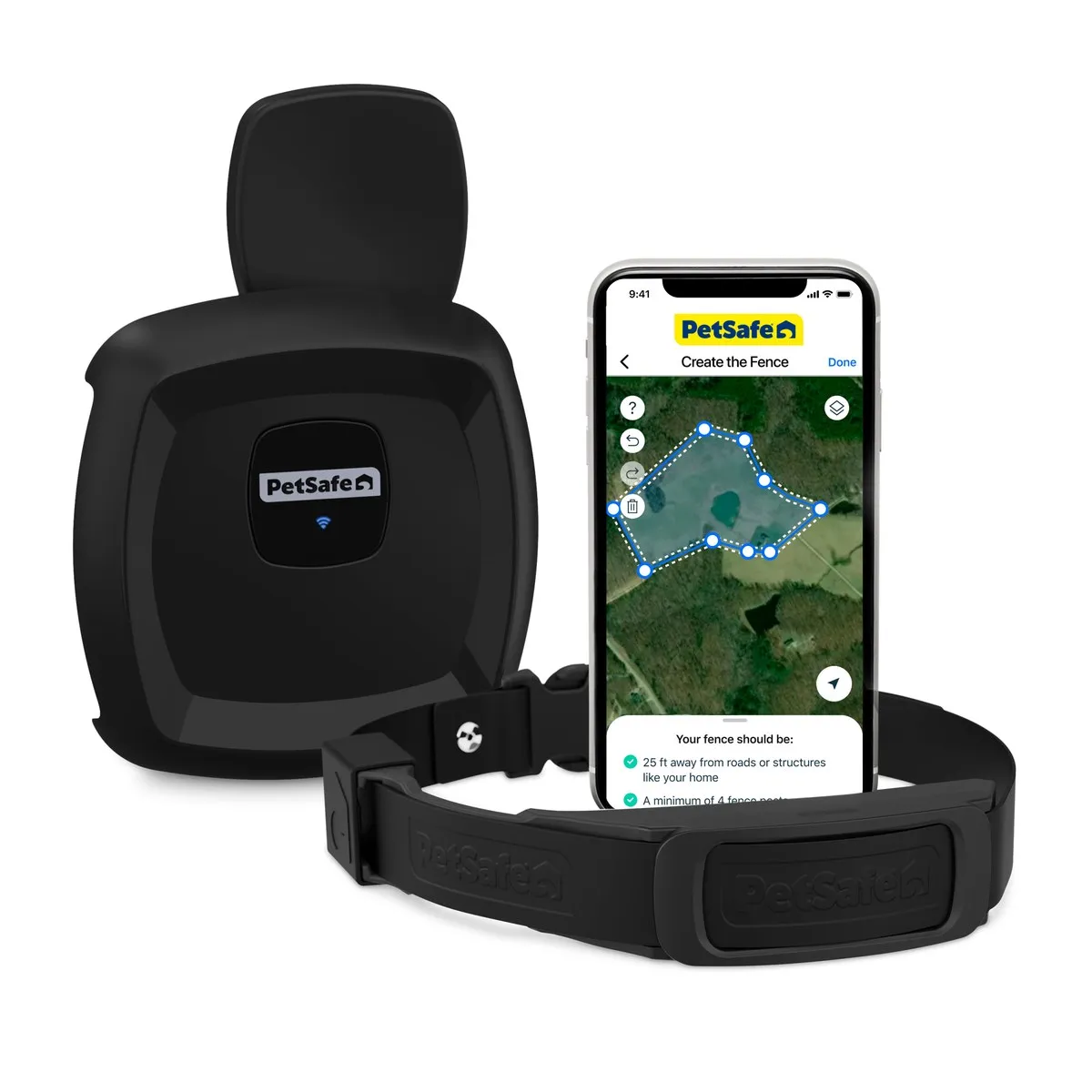
Containment is a claim about position, and there are three ways to make that claim. The maker of the systems discussed here publishes a comparison of all three, and it is more useful than most third-party roundups because it is the seller describing the limits of its own products.
The wired in-ground fence, per that guide, covers up to 25 acres, can trace any shape, and its signal follows the wire exactly and does not shift with weather, tree cover or nearby buildings. The wireless fence replaces the wire with a circular radio boundary that caps at about three quarters of an acre, which is the reason it suits small suburban yards and camping trips. The GPS fence replaces the transmitter with satellites, needs half an acre or more, and comes with a limitation the guide states plainly. Open sky matters, and dense tree cover, tall buildings and metal roofing overhead can slow the collar’s satellite fix. The guide’s own recommendation for wooded rural land is an in-ground system, because it does not depend on satellite reception.
| What decides the boundary | Coverage | Stated limit | Price | Rating on the seller’s page |
|---|---|---|---|---|
| Buried wire | Any shape, up to 25 acres | Wire can be cut; splice to repair | Kits vary | Not compared here |
| Radio circle | About 3/4 acre, circular | Circle only, and a yard boundary is rarely circular | $249.99 for the compact kit | 4.2 from 323 reviews |
| GPS, no subscription | Half an acre and up, any shape | Needs open sky | $389.99 | 4.0 from 189 reviews |
| GPS with tracking | Half an acre and up, any shape | Subscription and cellular service required | $379.99 | 3.6 from 183 reviews |
Look at the last two rows together, because they are the same maker selling two answers. The subscription-free fence page lists $389.99 with the words no subscription fees and a target property of three quarters of an acre or larger. The tracking model lists $379.99, needs a monthly or annual plan, states that cellular service is required for subscription GPS fences to function properly, and pitches itself at properties half an acre and up without dense tree coverage. Cheaper hardware, permanent monthly cost, and a safety function routed through a mobile network.
The ratings split in a pattern worth noting. The system pages carry the higher averages, 4.0 and 3.6, while the collars carry 3.3 from 226 reviews and 3.4 from 24. On the subscription-free unit, 29 of the 189 reviews are one-star, the dimension boxes read Quality 2.8 and Value 2.7, and a separate tally says 25 out of 47 reviewers recommend it. When the same product page reports both a 4.0 average and a 53% recommendation rate, the average is the weaker signal.
Then there are the two reports of the boundary going the wrong way, and they are different kinds of source. The first is the Trustpilot review of September 22, where the dog was corrected inside the perimeter, the owner could not get the collar off her, the unit now runs on pulse, and support’s explanation was that the house blocks the GPS. The second sits on the product page itself, where an owner with trees writes that it would sound when she was within the boundary, that it would occasionally stay silent when she walked outside the defined boundary, that the map in the app seemed inaccurate, and that she cannot trust it to contain her dogs. Read those two beside the maker’s own guide and the picture is consistent rather than contradictory. Tall buildings, roofs and tree cover degrade satellite fixes, so a house is a design input for a GPS boundary, not an excuse. The failure mode that follows is the worst one available. The collar fires at a dog that stayed home.
One more layer sits above all of that if you buy the tracking model. An owner in r/OpenDogTraining who runs a cellular GPS fence explained that the tone cannot be changed without the cellular subscription, that coverage is spotty in rural areas, and that the latency is too great for the collar to be used the way a trainer collar is used, which he described as its true purpose being containment. Another reply in the same thread describes buying a different GPS system, finding it made no contact, and being let down when it was needed. The structural point is not that one brand is worse. It is that a containment device whose correction layer depends on a cellular plan has a second failure mode that has nothing to do with the dog.
There is also the product that keeps getting asked for and does not exist at this scale. A hiker in r/OpenDogTraining wanted a collar that fires when the dog drifts more than a set distance from a moving owner, a virtual leash rather than a static fence, and found the closest thing too bulky for a 20-pound dog. The most-liked reply explains why nobody sells it. A boundary that moves with the handler cannot be learned by the animal, and the technology is not precise enough to be consistent. If a collar’s marketing implies that, read the acreage and sky conditions instead.
Check three: what happens when the model disappears
A dog device is not just hardware. It is hardware plus a supply line, and the supply line is the part nobody checks at the checkout.
The case study here costs $199 and no longer exists. Three Trustpilot reviews filed by one owner between September 20 and September 28, 2026 describe a PETLIBRO PLAF107 Space feeder bought for a large dog. The vacuum pump failed after about 10 months, and getting it replaced took five weeks of emails, video proof and a 90-minute phone call. Less than a year later, the replacement failed with the same vacuum pump. By the September 25 review the owner wrote that the model is no longer made, and that the proposed solution was a smaller feeder intended for cats and small dogs, which they had explained in writing would be useless before it was sent. The follow-up filed on September 28 adds the brand’s own words, that the offered resolution involving the Granary 2 Series was extended as a one-time courtesy and that this is the only resolution available at this time. The public reply the same owner received had promised contact within 24 hours and nobody contacted them.
The catalogue agrees with the reviews. Read on September 28, 2026, the brand’s own storefront feed returns 94 products and no Space feeder of any generation. The only dog-labelled items left in it are a dog fountain replacement filter at $22.99 and a subscription for that filter, while the dog fountain itself is not sold there. A large-dog feeder has been replaced in the lineup by feeders sized for cats, from $129.99 to $279.99, and the dog side of the catalogue has been reduced to a consumable.
The maker also filmed the failure, which is the cross-check. Its own channel carries a repair video titled AF107: Space Automatic Pet Feeder, Fix Air Pumping Failure, with 3,702 views on September 27, 2026. A support video exists because the fault generated enough calls to be worth filming, and the owner reports and the video name each other. The method of reading those libraries, along with the three ways a view count can mislead you, is written up in how to count repair videos.
Now generalise the arithmetic, because this is the check that transfers. On the dog side, the part that wears is the collar, and on the systems above it costs 60% to 70% of a new kit: $149.99 for a replacement receiver collar against a $249.99 wireless fence, $69.95 for a second trainer collar against a $99.99 system. That is survivable when the model is current and the part is stocked. It stops being survivable the moment the model leaves the catalogue, which is precisely what happened to the large-dog feeder, and it is why the brands that sell the wear part separately are the ones worth buying from. Ask three questions while the product page is still open. Does the model appear in the maker’s own catalogue today. Is the collar, pump, strap or battery sold as its own line item. And if the app is part of how the device works, what happens to the device when the app stops being updated.
What to use for the two jobs that are not correcting a dog
Most dog owners shopping in this category want two things done, and neither of them is an automatic correction.
The first is feeding on a schedule. That is a solved problem if you accept a plain design. The PetSafe Smart Feed lists at $134.99 with a 24-cup hopper, up to 12 meals a day between one eighth and four cups each, a four D-cell battery backup, and a lid, hopper, bowl and bowl holder that go in the dishwasher on the upper rack. Its limits are the ones that make it work. There is no camera and no subscription, the schedule lives on the device, and for two years running this site has printed the same caveat beside it, that the brand-level Trustpilot score is 2.1 from 231 reviews with no reply badge, and that one-star reviews for this exact model report it refusing to connect even to the right WiFi. Buy it for the offline schedule, not for the badge.
The second is knowing what happened while you were out. The TP-Link Tapo C210 records to a local microSD card, up to 512 GB, so verifying that a dog ate or that a gate stayed shut does not require a monthly plan, and our review covers what its night vision will not show. Nothing about this pair is exciting, which is the point. Neither device can fire anything at the animal.
For containment there is no affiliate link on this page, because the honest answer at this budget is still physical. A fence is not a gadget and it does not have a firmware problem. If a fence is impossible where you live, the alternative that trainers keep recommending in the threads above is a long line and two to three weeks of work, which is the same window the maker’s own guide names when it says the most common reason a system fails is training that was cut short rather than the collar. If you do buy a trainer collar, stay inside the two rules printed on its product page, never leave it on the dog for more than 12 consecutive hours, never attach a leash to it, and read the published veterinary position on aversive tools before you choose a method. If a subscription is part of a device whose job is your dog’s safety, read how these plans are structured first, because the layer that stops working when a plan lapses is the one you bought the device for.
The five-minute check before you pay
- Measure the neck against the published range, 10 to 22 inches on the trainer above, and confirm the collar is sold as its own item, because that is the part that wears.
- Read the wear-time rule on the product page, then read the one-star reviews on that same page, skipping any that carry a free-product tag.
- For any boundary, ask what the device does when its position fix is wrong. Tone first is a warning. A correction first is an accident waiting for a cloudy satellite day.
- Treat a subscription inside a safety device as a second failure mode, not as a feature tier, and read the acreage and tree-coverage limits the brand itself prints.
- Check the maker’s own catalogue for the model today, and the parts list for the collar, pump or battery, before you check the price.
None of that requires a review site, including this one. It requires a buyer who reads the specification table and the one-star bin, in that order, and who notices when the same page tells two different stories about how good its own product is.
FAQ
Does a GPS dog fence need a subscription? It depends on the model, and the two live side by side on the same brand’s site. The Guardian GPS Dog Fence is listed at $389.99 with the words subscription-free and no subscription fees, and the maker’s own fence guide describes it as the containment technology without live tracking. The Guardian GPS 2.0 Dog Fence + Tracking is listed at $379.99 and its page states that a subscription is required, that you choose a monthly or annual plan, and that cellular service is required for subscription GPS fences to function properly. If live tracking is the part you want, you are buying a data plan for a collar.
Do GPS fences work in a yard full of trees? The manufacturer says open sky matters. Its guide states that dense tree cover, tall buildings and metal roofing overhead can slow the collar’s satellite fix, and that on very wooded rural properties an in-ground fence is usually more reliable because it does not depend on satellite reception. The GPS 2.0 page narrows its own pitch to half an acre and up without dense tree coverage. One owner on that same product page wrote that the unit sounded when she was inside the boundary and sometimes stayed quiet when she stepped outside it, and blamed her tree coverage. That is the failure to test for before you rely on any boundary, because it corrects a dog that did nothing wrong.
How long can a training collar stay on a dog? Shorter than most buyers assume, and the brand prints it. The Pro Dog Trainer page says never to leave the collar on your dog for more than 12 consecutive hours, and not to attach a leash to it. Owners in r/OpenDogTraining describe the same rule, add that some dogs never settle with a receiver box against the neck, point to the maker’s comfort wings as a fix, and name the metal contact posts as the likely irritant for a dog that scratches at a switched-off collar.
What if the collar keeps coming off my dog? Treat it as a fit and hardware question before a training question. The trainer’s collar fits necks from 10 to 22 inches, and the brand’s copy promises a secure fastener and a more reliable fit. Against that, a Trustpilot review of September 22, 2026 reports the collar coming off within the first hour, and a review on the brand’s own page reports the plastic clip popping off several times a day. Measure the neck, confirm the collar is available as a replacement part, and use the return window, which that page states as 45 days, rather than modifying the strap.
Is there a welfare argument against these collars? Yes, and it is published by a veterinary body rather than by advocates. The American Veterinary Society of Animal Behavior states that aversive methods, including electronic collars, prong collars, choke chains and leash corrections, should not be used, and that it does not support the use of aversives in any context regardless of the tool or the trainer’s experience, citing risks to animal welfare and the human-animal bond. The devices remain legal and widely sold, and rules differ between countries and states, so check your own rules and work with a trainer if you use one.
Is the $199 PETLIBRO large-dog feeder still on sale? Not in the brand’s own catalogue on September 28, 2026. Its storefront feed returns 94 products and none is the PLAF107 Space feeder, and the only dog-labelled items left are a fountain replacement filter at $22.99 and a subscription for that filter. The three reviews behind this article describe the same vacuum-pump failure in the original and in its replacement, and name the $129.99 Granary 2 Series as what the brand offered instead. The brand also published a repair video for that pump failure.
What should I buy instead of a training collar or a containment fence? For feeding, a device whose schedule lives on the device, which is the reason the PetSafe Smart Feed appears here at $134.99 with a 24-cup hopper, 12 meals a day, a four D-cell backup and dishwasher-safe parts. For watching a dog at home, the TP-Link Tapo C210 records to a local microSD card, so verification needs no subscription. For containment, the honest answer at this budget is a physical fence, or a long line and training. petiqlab does not recommend a training collar or a GPS containment fence in this article, and no link on this page points to one.
Updated: 2026-09-28. Manufacturer pages, all read September 28, 2026: Pro Dog Trainer with Remote (PDT00-18038, $99.99, 1,000 ft range, 19 static levels, 10 to 22 inch necks, the 12-hour wear limit and the no-leash rule, the 4.1 average from 81 reviews with 44 five-star and 6 one-star, Quality 2.2 and Value 2.5, the Received Free Product tags, and the one-star report of the clip popping off daily), Guardian GPS Dog Fence (PIF00-17933, $389.99, subscription-free, three quarters of an acre and up, 4.0 from 189 reviews with 29 one-star, 25 of 47 recommend, Quality 2.8 and Value 2.7, and the owner review reporting the unit sounding inside the boundary and staying silent outside it), Guardian GPS 2.0 Dog Fence + Tracking (PIF00-18096, $379.99, 3.6 from 183 reviews, subscription and cellular service required, pitched at half an acre and up without dense tree coverage, plus the support answer that each pet needs its own collar and subscription), Wired vs Wireless vs GPS Dog Fence (the maker’s own acreage, tree-cover and satellite-limit statements and its note that most failures come from training cut short), the Stay & Play wireless fence line ($249.99 compact kit, $149.99 replacement receiver collar, $22.99 boundary flags) and the PETLIBRO storefront feed (94 products, no Space feeder, dog-labelled items limited to a $22.99 replacement filter and its subscription). Owner reports: petsafe.net on Trustpilot, 2.1 from 231 reviews, no reply badge, read September 28, 2026; the September 22, 2026 Pro Dog Trainer review (the collar off within the first hour); the September 22, 2026 Guardian GPS review (the dog shocked in the perimeter, pulse-only since, support pointing at the house); the PLAF107 large-dog feeder reviews of September 20, September 25 and September 28 2026 (the pump failing at ten months, the replacement failing the same way, the $129.99 cat feeder offered instead, the promised 24-hour contact that did not happen, and the brand’s written line about a one-time courtesy); petlibro.com on Trustpilot, 3.4 from 1,009 reviews with replies to 70% of negative reviews within two weeks; the PETLIBRO repair video for the AF107 space feeder air pump at 3,702 views on September 27, 2026. Owner threads, all read September 28, 2026: the GPS and e-collar experience thread in r/OpenDogTraining (the tone locked behind the cellular plan, the rural coverage gap and the latency, and the reply reporting a GPS system that made no contact), the mobile proximity collar thread (the 20-pound dog and the bulky collar, and why a moving boundary cannot be learned), the collar scratching thread (a switched-off collar, the comfort wings, the 24-hour warning and the metal posts), the wireless fence thread (half an acre, a circle, and a three-week battery with a preference for the rechargeable collar) and the Dogtra thread (the warning about $40 knock-offs and one owner’s note that collar use is restricted where they live). The AVSAB position statements page supplied the veterinary position on aversive tools, read the same day. Amazon links on this page carry our affiliate tag, and prices are list prices read from the product pages on September 28, 2026 rather than a promise about today’s retail price.